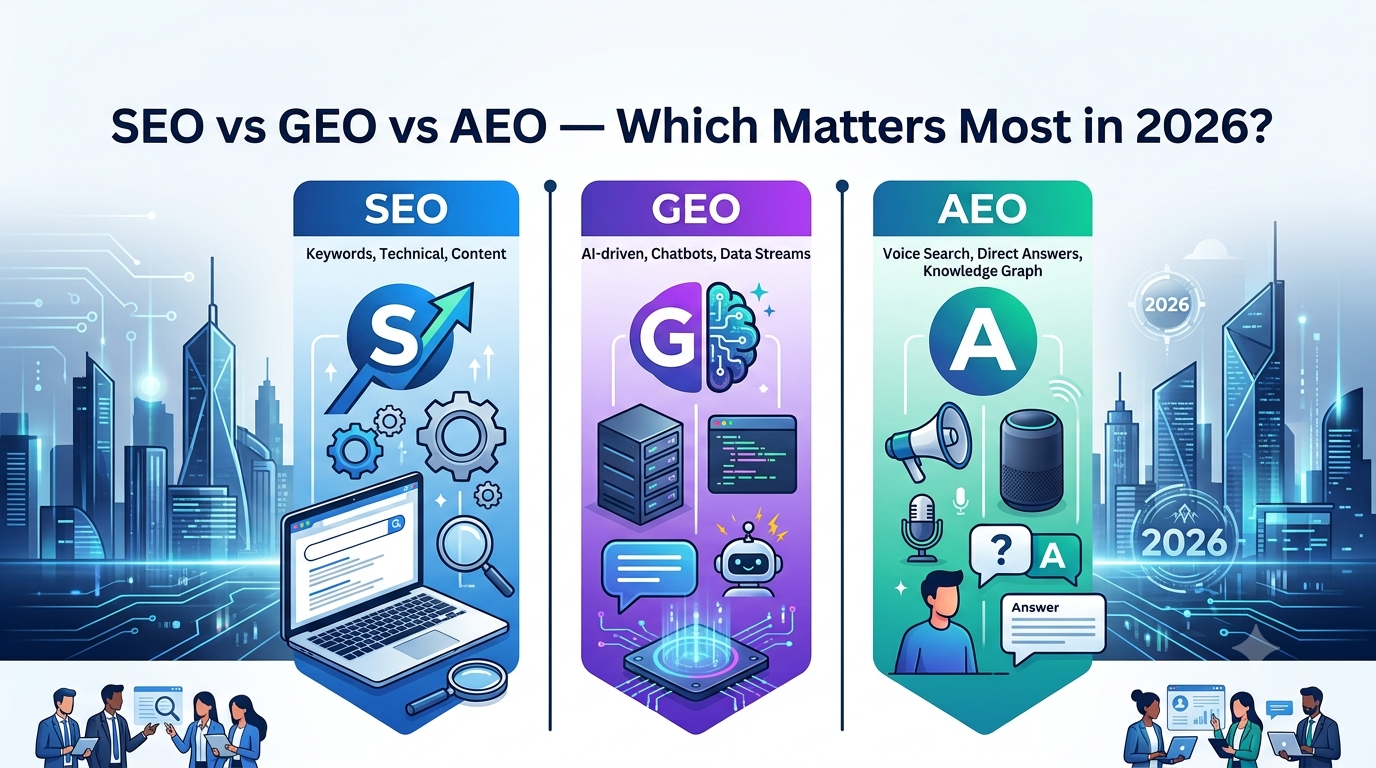
The Problem: Search Is No Longer a Single Channel
Picture a potential customer looking for an accounting firm in Kuala Lumpur. In 2020, they opened Google, typed "accounting firm KL", and scanned the first three results. Today in 2026, they might do any of the following:
- Search Google and click a blue link (traditional SEO)
- See a Google AI Overview at the top of the SERP and never scroll down (AEO territory)
- Ask ChatGPT "What accounting firms in KL are good for SMEs?" and get a direct recommendation (GEO territory)
- Ask Siri or Google Assistant on their phone (voice search / AEO)
- Search Perplexity for a comparison (GEO territory)
If your accounting firm only optimised for traditional Google rankings, you're winning one out of five possible discovery pathways. SEO, AEO, and GEO together cover all five.
What Is SEO (Search Engine Optimisation)?
SEO is the original and still foundational discipline. It's the practice of improving your website so it ranks higher in Google's (and Bing's) organic search results for relevant queries.
What SEO targets: Google blue-link rankings (positions 1–10 on page one). The primary goal is ranking high enough that users click through to your website.
How it works: Google evaluates over 200 ranking signals — technical site health, content quality and relevance, and off-page authority (backlinks). Getting all three right is what puts you on page one.
Why it still matters: Google processes 8.5 billion+ searches daily and commands 97% of Malaysia's search market (StatCounter, May 2025). Organic search drives 53% of all website traffic (BrightEdge, 2024). SEO remains the highest-ROI digital marketing channel when done right — and it's the foundation for both AEO and GEO success.
Timeline to results: 3–6 months for most Malaysian businesses; 9–12 months for highly competitive niches.
Best for: All businesses with a web presence. Non-negotiable as the foundation.
Learn more: What is SEO? A Complete Guide for Malaysian Businesses | SEO Malaysia Services
What Is AEO (Answer Engine Optimisation)?
AEO targets the answer-format results that appear above or instead of traditional blue links in Google Search. The term "answer engine" reflects the fact that Google now functions as much as an answer provider as a link directory.
What AEO targets:
- Featured snippets (the highlighted paragraph, list, or table at position zero)
- Google AI Overviews (Gemini-powered answer boxes, appearing on ~46% of searches)
- People Also Ask (PAA) boxes
- Voice search answers (Google Assistant, Siri)
- Knowledge panels
How it works: AEO is about content structure. You write concise, direct answers (40–60 words) directly below question-format headings. You use FAQPage schema markup, structured lists, and HTML tables. Google's algorithms pull this structured content into answer boxes.
Why it matters in 2026: AI Overviews appear on 46% of Google SERPs. Featured snippets capture ~8% of all clicks for their trigger query — entirely from users who might otherwise click past your site. For informational queries (which dominate voice search), AEO is the difference between existing and being invisible to a large segment of your audience.
Timeline to results: 6–12 weeks once structured content is indexed and ranking on page one.
Best for: Businesses with informational content needs — professional services, education, healthcare, financial services, e-commerce product Q&A.
Learn more: Answer Engine Optimisation (AEO) Malaysia
What Is GEO (Generative Engine Optimisation)?
GEO is the newest discipline — emerging in response to the rapid adoption of AI chatbots as a search alternative. Where AEO targets Google's AI features, GEO targets AI-native platforms like ChatGPT and Perplexity that generate answers from scratch.
What GEO targets: Brand citation within AI-generated responses on ChatGPT, Perplexity, Google Gemini (standalone app), Microsoft Copilot, and similar platforms.
How it works: AI models synthesise information from their training data and (for web-connected platforms) real-time web results. They cite brands that demonstrate topical authority, consistent expert positioning, and strong third-party credibility signals (authoritative backlinks, media coverage, entity schema). GEO is about building exactly those signals deliberately.
Why it matters in 2026: ChatGPT reached 100 million weekly active users by January 2024. Perplexity processes 100M+ queries monthly. A growing portion of Malaysia's tech-savvy audience — particularly professionals, researchers, and Gen Z — turns to AI chatbots for recommendations, comparisons, and how-to guidance. If you're not in those AI answers, you don't exist for this audience.
Timeline to results: 6–12 months (authority building is cumulative; it cannot be rushed).
Best for: B2B businesses, professional services, SaaS, education, healthcare, and any brand where trust and expertise are core purchase drivers.
Learn more: Generative Engine Optimisation (GEO) Malaysia | How to Get Cited by ChatGPT
SEO vs AEO vs GEO: The Complete Comparison
| Dimension | SEO | AEO | GEO |
|---|---|---|---|
| Primary target | Google blue links | Answer boxes in Google SERP | AI chatbot citations |
| User behaviour | Click link to visit site | Read answer; may or may not click | Read AI answer; rarely visits site |
| Content approach | Comprehensive, keyword-rich pages | Concise Q&A, structured lists/tables | Authoritative, citable, data-rich |
| Schema needed | Organisation, LocalBusiness, Service | FAQPage, HowTo, Speakable | Organization, Article, ClaimReview, Person |
| Key off-page signal | Backlinks / domain authority | Page-one ranking + structured content | Media citations + topical authority |
| Timeline to results | 3–6 months | 6–12 weeks | 6–12 months |
| Traffic type | Organic clicks to your site | Brand visibility + some clicks | Brand awareness (impressions, not clicks) |
| ROI measurement | Traffic, rankings, conversions | Snippet ownership %, AI Overview inclusions | AI mention frequency, brand recall |
Which Should You Prioritise — and in What Order?
The answer depends on your business type, current digital maturity, and marketing budget. Here's our recommended prioritisation framework for Malaysian businesses:
If you have no SEO at all: Start with SEO. It's the foundation — and both AEO and GEO will perform better on top of a strong SEO base. Technical health, content quality, and domain authority are shared requirements for all three disciplines.
If you have basic SEO but no page-one rankings yet: Continue building SEO while adding AEO structuring to your content. AEO doesn't require significant additional effort — it's mostly about restructuring how you write existing content. The same structured content that wins snippets also improves on-page SEO quality.
If you're ranking on page one for core keywords: Add AEO to convert rankings into snippets, and start GEO foundations (entity schema, original data assets, expert positioning). This is where the competitive advantage grows significantly.
If you're a professional services firm or B2B business: GEO should be high priority even earlier. When potential clients ask ChatGPT "What's the best accounting firm in KL?", being cited provides direct lead generation impact.
If you have limited budget: Focus 70% on SEO, 30% on AEO content structuring (minimal extra cost on top of content creation). Delay GEO until you have sufficient authority built through SEO and link-building efforts.
The Bottom Line
SEO, AEO, and GEO are not alternatives — they are complementary layers of a complete 2026 search visibility strategy. SEO builds the foundation, AEO captures the zero-click opportunity within Google, and GEO extends your brand presence into AI-native search environments.
The Malaysian businesses that will dominate their categories over the next 3–5 years are those investing in all three now — while most competitors are still debating whether AI search is real.
Ready to build your three-layer strategy? Contact our team for a free consultation — we'll analyse your current search visibility across all three dimensions and map a 12-month roadmap.