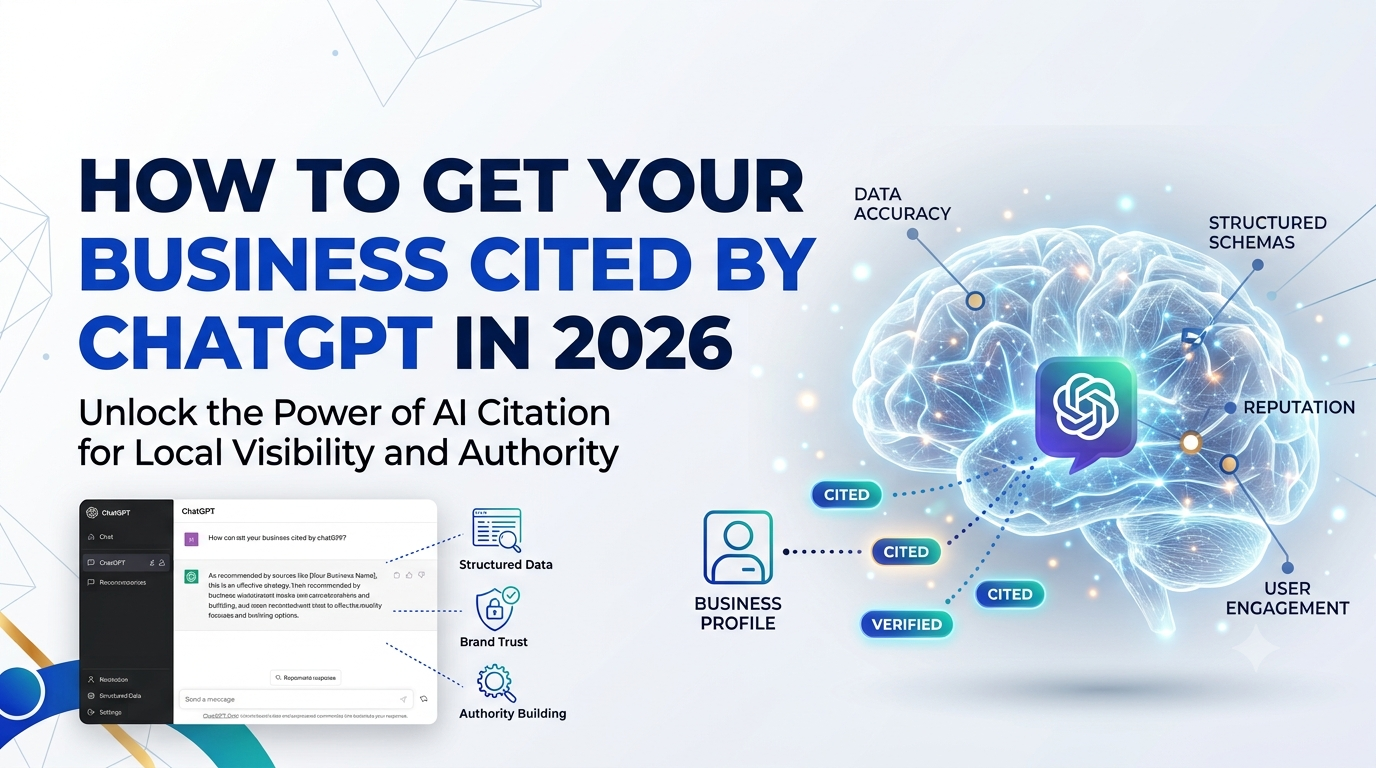
First: How Does ChatGPT Decide Who to Recommend?
Understanding the mechanism is essential to GEO. ChatGPT and similar AI platforms (Perplexity, Gemini, Copilot) generate answers by synthesising information from two primary sources:
- Training data: The massive corpus of text (web pages, books, articles) that the model was trained on. Brands that appear frequently, authoritatively, and consistently in this data are better represented in the model's "knowledge".
- Real-time web search: Many AI platforms (ChatGPT with browsing, Perplexity, Gemini with Google Search) also search the live web when answering queries. They retrieve and synthesise the most authoritative, relevant, recently-indexed content.
Your GEO strategy must address both: building a strong historical presence in authoritative web content (for training data) and maintaining a current, well-structured, highly-cited web presence (for real-time retrieval).
Step 1: Conduct a GEO Visibility Audit
Before optimising, you need to know your starting point. A GEO audit involves systematically querying AI platforms with questions relevant to your business:
- "What are the best [your category] in [your city/Malaysia]?"
- "Who is the most trusted [your profession] in Malaysia?"
- "What should I look for when choosing a [your service]?"
- "Recommend some [your category] companies in Malaysia"
Run these queries across ChatGPT (4o), Perplexity (both with and without "Pro Search"), Google Gemini, and Bing Copilot. Note:
- Which brands are cited — are any of your competitors appearing?
- What types of content are cited (articles, directories, news coverage)?
- What aspects of the topic are covered — and what gaps exist?
This audit gives you a clear picture of the gap between your current AI visibility and where you need to be.
Step 2: Build Topical Authority Through Content Clusters
The single most impactful GEO tactic is topical authority — the depth and breadth of your expertise demonstrated across all content on your site.
AI models are remarkably good at identifying whether a source is truly expert in a topic or merely covering it superficially. A website with one generic "SEO services" page is far less likely to be cited than a site with 50 interconnected, deep pages covering every aspect of SEO for the Malaysian market.
The hub-and-spoke model: Build a central "pillar" page on your core topic (e.g., "SEO Malaysia"), then create multiple "spoke" pages covering related subtopics (technical SEO, local SEO, link building, AEO, GEO, pricing, etc.). Interlink them thoroughly. This architecture signals that your site is the definitive resource on the subject.
For Malaysian businesses, ensure your content covers:
- Location-specific variants (KL, Penang, JB, etc.)
- Bilingual content where your audience searches in Bahasa Malaysia
- Industry-specific applications of your service
- FAQ-format content addressing every common question in your niche
Step 3: Create Original Data and Research Assets
Original data is the most powerful GEO content type. When you publish a genuine piece of research — a survey, industry benchmark report, pricing study, or data analysis — other writers, publications, and blogs naturally cite your findings. These citations accumulate in the web corpus that AI models draw from.
Examples of original data content Malaysian businesses can create:
- For an SEO agency: "Malaysia SEO Pricing Survey 2026 — Data from 50 Agencies"
- For a law firm: "Malaysia Commercial Dispute Trends 2025 — Analysis of 200 Cases"
- For a property developer: "Penang Property Price Index Q2 2026"
- For an HR software company: "Malaysia Employee Retention Report 2026 — 500 HR Leaders Surveyed"
These data assets generate natural third-party citations, which accumulate into the kind of authoritative web presence that AI models trust and reference.
Step 4: Earn Authoritative Third-Party Citations
AI models heavily weight third-party citations — mentions, links, and references from credible sources outside your own website. The more authoritative the source, the stronger the signal.
High-value citation sources for Malaysian businesses include:
- Malaysian national media: The Edge, The Star, Malay Mail, Malaysiakini, Sin Chew Daily
- Industry bodies: MATRADE, MDEC, SME Corp Malaysia, MaGIC
- International publications covering Malaysian business: Bloomberg Asia, Reuters, Forbes (Asia)
- Academic and research institutions: local university publications, MIER
- Business directories with editorial curation: Company registration databases, award programmes
Tactics to earn these citations:
- Digital PR: Pitch stories, expert commentary, and data studies to Malaysian journalists
- HARO-style outreach: Position your team members as expert sources for journalist queries
- Industry awards: Being listed as a finalist or winner in industry awards generates credible third-party mentions
- Speaking engagements: Industry conference talks and webinars generate event listing citations and media coverage
- Collaborative content: Co-author reports or case studies with other credible organisations
Step 5: Implement Comprehensive Entity Schema Markup
Schema.org structured data helps AI platforms correctly identify and understand your organisation, the topics you cover, and the expertise you have. Think of it as a machine-readable business card that AI models can parse precisely.
Essential schema types for GEO:
- Organization: Legal name, address, phone, email, sameAs links (Wikipedia if applicable, LinkedIn, Crunchbase)
- Person: For key team members — credentials, expertise, publications
- Article: On all blog posts and pillar content — author, datePublished, dateModified
- FAQPage: On all pages with Q&A content
- Service / LocalBusiness: On service pages with clear service description and area served
- ClaimReview: If you publish fact-checks or data analyses
The "sameAs" property in Organization schema is particularly powerful for GEO — it links your website entity to the same entity in Wikidata, Crunchbase, LinkedIn, and other databases that AI training data includes. This entity co-reference strengthens AI models' ability to identify and recommend your brand correctly.
Step 6: Build E-E-A-T Signals Across Your Entire Web Presence
Google's E-E-A-T framework (Experience, Expertise, Authoritativeness, Trustworthiness) is the closest public description of what AI models consider when evaluating source credibility. The same signals matter for GEO.
- Experience: Demonstrate real-world case studies, client results, and project portfolios. AI models recognise first-hand experience markers in content.
- Expertise: Author credentials, certifications, qualifications, and specialised knowledge demonstrated throughout content.
- Authoritativeness: Third-party recognition — awards, media coverage, industry citations, speaking invitations.
- Trustworthiness: Business transparency — physical address, company registration details, clear contact information, privacy policy, verified reviews.
Step 7: Monitor, Measure, and Iterate
GEO is an ongoing discipline, not a one-time project. Establish a regular monitoring cadence:
- Weekly: Check your primary 10–20 target queries across ChatGPT, Perplexity, and Gemini
- Monthly: Run a full 50-query AI audit; track citation frequency trends
- Quarterly: Review which content assets are being cited; create more in successful formats
- After major content publications: Test new content within 2–4 weeks to see if it appears in AI responses
GEO is a compounding strategy. Each piece of authoritative content, each earned citation, and each piece of entity data adds to the cumulative signal. Results typically become visible at 3–6 months and grow significantly over 12+ months.
What Makes GEO Different for the Malaysian Market?
Malaysian-specific GEO considerations include:
- Bilingual content matters: Perplexity and ChatGPT process both English and Bahasa Malaysia queries. Having authoritative BM content increases your citation eligibility for BM-language AI queries.
- Malaysian authority sources are underutilised: Most Malaysian businesses haven't invested in getting cited by The Edge, MDEC, or SME Corp. The bar for getting cited by these sources — and therefore improving AI visibility — is lower than in saturated Western markets.
- Local entity data matters: Google Gemini increasingly uses Google Maps, Google Business Profile, and Google Knowledge Graph data in its responses. A well-optimised GBP with comprehensive information, strong review signals, and correct entity data improves Gemini citation likelihood.
"The brands that win GEO are not the ones trying to game AI systems — they're the ones investing in genuine expertise, transparent credibility, and consistently helpful content. AI models are surprisingly good at recognising the difference." — AI SEO Experts, 2026
Getting Started with GEO: Your First 30 Days
Here's a practical first-month plan for Malaysian businesses starting GEO:
- Week 1: Conduct your GEO visibility audit. Run 50+ AI queries across ChatGPT, Perplexity, and Gemini. Document who is being cited for your target topics.
- Week 2: Implement entity schema (Organization, Article, FAQPage) across your entire site. Set up your Google Business Profile if not already done.
- Week 3: Audit your topical authority gaps. Identify the 10 most common questions AI platforms answer about your industry, and create/enhance content to answer them definitively.
- Week 4: Identify your first original data asset opportunity. Survey your clients, analyse your own data, or compile industry statistics into a citable resource. Begin outreach to 3–5 Malaysian media contacts for expert commentary opportunities.
GEO is a long game, but the first 30 days of foundation-setting have a disproportionate impact. Brands that start building GEO authority now will be significantly ahead when AI search adoption accelerates further in 2027 and beyond.
Want help building your GEO strategy? Contact our team — we offer free GEO visibility audits that show you exactly where your brand stands across ChatGPT, Perplexity, and Gemini today.